1/29/12; MEAT IS MEAT by Samantha Crossley+
Fourth Sunday after Epiphany; Deuteronomy 18:15-20, Psalm 111, 1 Corinthians 8:1-13, Mark 1:21-28
Oh man. Idol worship. Sacrificed meat. Exorcising demons. Not a comfortable set of lessons for an enlightened group of 21st century folks. Meat is meat – you can argue whether or not it is good for you, but not from a spiritual standpoint. Demons, well, thanks to medical science, we know that convulsions aren’t caused by evil spirits and we don’t spend much time or energy trying to exorcise epileptics. Or maybe these lesson are actually too comfortable for us. We pull out our modern cultural perspective and dismiss these readings as the products of a pre-science world and neglect to find what the message is for us.
Fred Craddock is a famous homiletics professor. He tells the story of a young minister. Fresh from seminary. He’s new and nervous and wants to do everything right. He is called to his first parish and eventually is called to make a pastoral call to an ailing, elderly pillar of the church. The woman had severe chronic respiratory issues and has contracted pneumonia as well. There is no hope for her recovery. The family calls this young, inexperienced, sincere new minister to pray with her, anoint her, give her a last communion. On the ride over he agonizes over the words to say, how to give comfort to this dying woman, prays that he can communicate God’s love to her.
He comes to the woman’s room. She is frail and ill. They chat for a bit, nothing earth shattering, and eventually he asks if she would like him to pray for her. “Well, of course, that’s what I wanted you to come for.” He then politely asks, “And what would you like me to pray for?” The old woman looks him straight in the eye and says, “I want you to pray that God will heal me.”
The young pastor is a bit surprised by the answer – doesn’t she know that she is dying? Flustered, he takes her hands and starts fumbling over the words. Somewhere in the flurry of words he ends up praying for what she asked – that God would heal her. When he finally says the Amen at the end of the prayer, the woman says, “You know, I think it worked! I think I’m healed!” And she gets out of bed and begins to run up and down the hallway of the hospital yelling, “Praise God! I’m healed! Praise God! I’m healed!”
Meanwhile, the young pastor stumbles to the stairwell, makes his way to the parking lot and somehow manages to find his car. As he fumbles to get his keys out of his pocket, he slumps back in the seat and looks heavenward and yells, “Don’t you ever do that to me again!”
That poor minister. He “knew” things didn’t work that way. Knowledge puffs up, and the poor man was deflated. Great are the works of the LORD.
We do so love to be right. To be in the know. Not just to know things, but to know more than the other guy. Paul says, anyone who claims to know something does not yet have the necessary knowledge. It’s the Pauline version of Robert McKloskey’s, “I know that you believe you understand what you think I said, but I’m not sure you realize that what you heard is not what I meant.”
The Corinthians knew that idols meant nothing in the face of the one true God. They knew meat was just…meat. Paul didn’t argue with that truth. The Corinthians use this “knowledge” in a game of one-upsmanship with their “brothers” who followed their consciences to deny themselves the tainted treat. Paul struggles to explain that “right” is not the issue. Love is the issue. Knowledge can steer you wrong. We must meet our brothers and sisters where they live, and love them.
Doesn’t apply to us? Sacrificed meat not such a divisive issue? How about creationism? Literal biblical interpretation? Gay marriage? Agnosticism? Women in ministry? Using contemporary words to the Lord’s prayer? We all have opinions. And we all know we’re right.
Have you heard of the Episcopal Story Project? It is a new effort to collect the stories of Episcopalians on line. It’s just starting up, and just has a few entries. One is from Mark Osler, an attorney, who is talking about how to have a meaningful conversation about a controversial topic. I won’t repeat the whole speech. (It’s worth taking a look at). Pertinent to today, he talks about a technique used by attorneys. When there is an exhibit to look at, they have two choices. They can stand behind it, thus (demonstrating), and show it to the jury. Or they can place it up front, walk to the jury, turn around and say, “Let’s look at this together”. It’s a visual cue for what needs to happen for people to connect. “What you have to do is walk to them, turn around, and walk with them, back to where you want to go.” It’s a walk across the courtroom for the attorney. It’s a journey of love for us. A transformative process for everyone involved. As Maya Angelou said “I’ve learned that people will forget what you said, people will forget what you did, but people will never forget how you made them feel.”
Jesus went to the synagogue, the place where his brothers and sisters would have gathered every week, not just to worship, but as a way of life. He spoke, and they knew his authority, just from his few words. The scribes had knowledge. They knew what was “right”. Jesus’s authority doesn’t spring from what he knows, or from being correct. Presumably he was – we don’t even know what he taught that day. Jesus joined them where they were, right or wrong, enlightened or not, with such demons as they carried. The love of God flowed through him, the Holy One of God, and with it came authority and healing.
Great are the works of the LORD!
Let the love of God flow through you. You don’t have to change your convictions. Truth is still truth. Just let God’s love greet your brothers and sisters where they are, with all their new-fangled or old fashioned ideas, all their demons, all their issues. You are God’s messenger, God’s prophet. Remember, they will forget what you say, forget what you do, but they will never forget how you made them feel.
Great are the works of the LORD! Praise be to God.
1/22/12; GOING FISHING by Samantha Crossley+
Third Sunday after Epiphany, Jonah 3:1-5, 10, Mark 1:14-20
What would make you stop your life as you know it and follow a completely different path? A new job? A new life partner? A promise of another climate? A better living situation? How about a seemingly random summons from an itinerant carpenter with no promises of security, safety, social acceptance, or even a bed to sleep in? It was enough for Simon, Andrew, James and John. Jesus called to them;
offered them a completely impossible life. They dropped their lives, their identities and they followed him.
I don’t know about you, but I reluctantly find myself identifying much more with the more practical, less compliant Jonah.
We didn’t read the whole story of Jonah this morning. You all know the story, though, right? Abbreviated version: God says to Jonah, “Jonah, I’ve got a job for you to do.” Jonah says, “Um, what?” God says, “Go to Ninevah, tell them they’ve got it all wrong and they should change it up”. Jonah says, “You want me to go a city that embodies pure evil, one that I would happily see wiped from the face of the earth, a place where they would just as soon kill me as look at me and say, ‘Oops, sorry folks, completely change the essence of your being or be destroyed’. Uh, yeah, sure, God, I’ll get right on that.”
Except that Jonah doesn’t go to Ninevah, he hops a ship to Tarshish – closest thing he could figure to the end of the earth. A horrendous storm blows up and the sailors say, “You’re a God person. Talk to God and get us out of this.” Jonah says, “Yeah, God and I are not getting along all that well right now. Actually, I pretty much disobeyed a direct order and am presently AWOL.” “Right then”, say the sailors, “out you go.” They toss him off the ship, where he’s eaten by a great monster of a fish.
Three days in the digestive tract of a fish gives a person plenty of time to work on their spiritual life with very few distractions. So Jonah prays. A lot. God finally decides Jonah’s had enough and the fish vomits him unceremoniously on land. “Ok, then, Jonah, let’s try this again” says God. “Go…to…Ninevah.” That is where we join the story today. Jonah goes, delivers the message as succinctly as possible, “You’ve got 40 days, then you’re toast.” Ninevah as a whole believes him, and that quintessential seat of evil does a complete 180 right down to the sackcloth and ashes. And God spares them.
The story of Jonah is usually told with a whale playing the role of the “great fish” but the scriptures are not specific and scholars doubt it was actually a whale. A number of more likely species have been suggested, as outlined by specialist Brian Donst. One possibility that has been proposed is Icthusius apathensis, an overwhelmingly large, oblivious fish with the common name of Large-apathy bass. A related possibility is the Ichthusius privatus paradiso. This prolific fish, more commonly known as the “Feather-my-nest fish” is often found indoors in huge rooms with vaulted ceilings nestled among more things than can possibly ever be useful. Consideration must also be given to Fishensius frightensius; also known as the Timid Fish or the “What-can-I-Do Walleye”. This interesting creature is known for swimming away from any kind of turbulence, apparently feeling inadequate to negotiate any kind of troubled water. Interestingly, if thrown into rough waters the Timid Fish typically functions quite reasonably. Perhaps the strongest contender in Jonah’s case is the great Rightensiusindignatus. According to Donst “a very ancient fish that somehow always swims upward and in straight lines and looks either sorrowfully or disdainfully at more wayward fish around it that seem to be swimming in unhealthy ways, but doesn’t really get involved with them, just watches them swim to their end.”
You may hear people question whether this could actually happen. Could a human being actually spend 3 days in the bellies of one of these beasts, and live to tell the tale? All these fish are alive and swimming in today’s world, and I am here to tell you from personal experience that we humans can spend days, months, even years in the bellies of these and similar beasts, seemingly cut off from God and God’s world. It happens every day. And although the process of exiting the beasts may not be pretty, we can survive it, and God still has this job for us to do when we escape.
We know very little about the fishermen Mark describes before Jesus called out their names with his preposterous proposal. They may well have wrestled with the species I’ve described. We do know that they were working men with families and livelihoods and presumably all the messiness and confusion in their lives that has always accompanied the human condition. These were not young kids following a crazy fad, or people with nothing to lose. Yet they responded “immediately” to Jesus’s summons, leaving hearth, home and family.
Poet Timothy Haut writes:
A distant bell rings
Through the morning fog.
There is the slap of nets on water,
And a sudden flurry of birds
Stirring the sky.
The two fishermen are weary
Though the day is just beginning.
They sense that the seasons of their lives
Are slipping away,
Like silver fish seeking
Deeper water.
They can not see beyond the horizon–
Not the farther shore of the sea,
The green hills where a strange world is hidden,
And not the uncertain shores
Of their own mysterious lives.
Something has stirred in them, too,
This voice calling them,
This presence casting a net over their hearts,
Tugging them somewhere
Yet to be discovered.
“You will always be fishing,” the man had said,
“But it will not just be fish that you seek.”
The brothers feel the sun
Shining on their sweating faces.
They know that whatever will come,
They are in it together.
The younger one shades his eyes,
Squints at the man coming down the road,
Waving toward them.
They are caught by love.
Remember that God’s love is with us, even when we languish in the bellies of our own personal monsters. Jesus asks for nothing less than our lives, and offered nothing less than his own in the service of that great love. Listen for your name. Know that God is calling you. As that call becomes clear, you may have to forgive yourself a brief Jonah moment of “Who me? You want me to do WHAT?” But then drop your net and open your heart and follow the love that is Jesus Christ. After all, you may not be called to go to Ninevah, you may be called to go fishing. And oh, what a fishing trip it will be….
Thanks be to God!
Amen
1/8/12; EUREKA! by Samantha Crossley+
Epiphany; Isaiah 60:1-6, Matthew 2:1-12
This morning we celebrate Epiphany. Epiphanies (with a lower case “e”), as opposed to slow, plodding, deliberate work, have been touted as the movers and shakers of big ideas. If we stay, for the moment, outside the religious realm, Archimedes provides one of the most famous examples. Archimedes was a Greek mathematician, inventor, engineer and physicist who lived a couple hundred years before Jesus was born. Archimedes was placed in the awkward position of figuring out whether a gift to a king, a crown, was real gold or something cheaper and less dense. This happened a couple thousand years before mass spectrometry came around, and in those days, an object needed to be a nice regular shape to figure out its volume and thereby calculate its density. Archimedes was in a bad spot though, because it was considered very bad form to melt down the king’s crown to see if it was made on the cheap. Archimedes struggled with the issue, and struggled with it, and finally went off to take a bath, without solving the question. When he got in the bath, he happened to notice the water rose as he sat down, and suddenly realized that the volume of the water moved would be the same as the volume of the thing put in the water. His problem was solved. Legend has it, he was so excited he jumped out of the bath and ran down the streets stark naked, yelling “Eureka!”
Isaac Newton is famously said to have experienced a similar dramatic experience of an unexpected truth suddenly becoming obvious when he got conked on the noggin by an apple and suddenly put the whole radical gravity idea together. As far as I have heard tell, at least Newton managed to keep his clothes on in the process.
Epiphany (from the ancient Greek, “showing” or “manifestation”) is the sudden realization or comprehension of the (larger) essence or meaning of something. We kind of like the idea of epiphanies, because they seem to suggest that nothing more is required of us than to take a nice relaxing bath, or sit under an apple tree and truth in all its glory will be revealed. But it turns out that Archimedes and Newton did a great deal of thinking and work and study before that inspiring bath, and before the fateful apple – head bonking.
Our Holy Day “Epiphany” (Epiphany with a capital “E”) is another sort of “showing”. In this case it is the manifestation of the babe Jesus to the Gentiles, in the form of the wise men, as the King, the Son of God.
We know very little about the wise men, the Magi, not even how many there were (all the songs and stories notwithstanding). The Gospel makes it clear there were more than one, but never gives a number. They were probably followers of Zoroastrianism, well known and, in their day, respected astrologers. They were looking for something. They were diligent and disciplined and they looked in the only way that they knew, by watching the stars. Eventually their discipline and dedication led them on a long, uncomfortable journey. After an awkward encounter with the powerful, ambitious and brutal Herod, they followed their beacon in the darkness to something they never expected, an ordinary infant resting in the arms of a teenage mother in an ordinary stable. This combination does not sound like a recipe for success in the world of royalty, but clearly the wise men recognized the truth of Jesus’ kingship immediately: “They were overwhelmed with joy… they knelt down and paid him homage. Then, opening their treasure chests, they offered him gifts of gold, frankincense, and myrrh.
(The gifts, incidentally, have developed their own symbolism in relation to Jesus’ life: gold for kingship, frankincense, a type of incense for deity, and myrrh, an ointment used for preparation for burial, symbolizes sorrow and death. But I digress)
“Arise, shine; for your light has come, and the glory of the LORD has risen upon you.” This sounds like such a gift, and indeed it is. But this is not the sort of gift that you sit and wait for, where the only work required is to unwrap it when it arrives under the tree.
Like Archimedes before them and Newton many centuries later, the magi studied, worked, observed. When there was action to be taken, the magi took it, traveling at least 300 hot, dusty miles west to follow the light. When they experienced truth, they were open enough to recognize it and cherish it, although it could not have been in the form they were expecting.
The magi’s journey was not the same as that of Mary and Joseph, or of Matthew’s jewish listeners. The magi could not have found God incarnate by studying the Torah or listening to angels in a dream. Those things would not have made sense to them. They did their spiritual work in another way.
My journey is not your journey, and I cannot tell you what work needs to be done in your journey, only that there is work. Prayer, study, deliberate mindfulness, a helping hand to a neighbor, extending welcome to a stranger. You must discover what furthers your journey. Not what is easy, but what brings you closer to Emmanuel, to God with us.
Understand that in your journey you may need to cross uncomfortable spiritual deserts. Understand that you may need to ask directions along the way. Understand that when the epiphanies come (not “if”, “when”), they may not be in the form that you expect, or resemble what you might want. Understand that, like the magi, who “left by another road” after paying homage to the infant king, your course will be forever changed. One does not meet God and remain unchanged. Nonetheless, let us heed the voice of the prophet Isaiah, “Lift up your eyes and look around…Then you shall see and be radiant; your heart shall thrill and rejoice.”
1/1/12; ABBA! FATHER! by Samantha Crossley+
First Sunday after Christmas; Isaiah 61:10-62:3, Galatians 4:4-7, Luke 2:22-40
Well, here we are, we’ve done it. Christmas day is done and gone. The waiting days of Advent, pregnant with anticipation of the coming Christ, came to their climax in the celebration of Jesus’s birth Christmas Eve. Christmas dinner has been served, and all the dishes are cleaned. The shepherds have gone home with their sheep, and the cattle are lowing elsewhere. The aisles and aisles of Christmas finery in the stores have been packed away in some stores and deeply discounted in others to make room for Valentine’s and Easter displays. It’s a time that leaves us in danger of feeling shiftless, ungrounded, even let down. You wonder if Mary and Joseph felt that as they took on their new parental responsibilities. New, young parents. Traveling, yet again, this time to the temple, for Mary’s purification (a ritual required of all observant Jewish women after all that messy childbirth business), and to offer sacrifice for their first born. It’s the spiritual equivalent of post partum depression, as we face an ending and a return to “normal life” (whatever that is), where we had for so long anticipated a beginning, and new life.
Fortunately, we have Paul today to rescue us from any sense of ennui. Paul brings us back to Christmas with his own birth narrative, “But when the fullness of time had come, God sent his Son, born of a woman, born under the law.” No census, no mangers, no shepherds, no angels. Simply this, the time was right and God offered this incomparable gift, born of us, to be one of us, to share and live with us. Paul goes on to explain the real implication of this – God has sent the Spirit of his Son into our hearts, crying, “Abba! Father!” “Abba” is the aramaic equivalent of “Daddy”, or “Papa”. We know it from the intimate prayer of Jesus to his Father as he approaches the day of his death. The point of Jesus coming, being born human, if we are to believe Paul, is that we might know ourselves as children of God.
God’s son was born into financial poverty. The rather famous conditions of his birth itself suggest that. That could, theoretically, have had as much to do with a crowded town as a lack of means. But in the aftermath of that first Christmas Mary and Joseph get back to the business of the day, offering two turtle doves (or pigeons) in sacrifice for their firstborn as required by the law. If they had money or means, the law would have required a lamb.
I had the opportunity yesterday to meet a young family who, in the wake of Christmas, had nothing. Through a variety of circumstances this family found themselves without a home, without means of support, without food, simply without. They were hungry, and did not know where to turn. They met someone else, who had a house that they could use. Now they are warm and dry and together. The person with the house knew people who could spare food and furniture and books. Now this wonderful little family can sit together at the dinner table. They have something to put on the dinner table to eat. Out of the ashes of their old, broken lives, a new life is beginning. God’s work was done in their lives. The work was not done as part of any church, or organization, just one child of God serving other children of God.
This is not the time to lament the endings. This is the time to be about God’s work. To join with Simeon in blessing the Holy One. To join with Anna in praising God. To be the gifted children that God has created us to be. To bring God’s graciousness and love into all his children’s lives.
Today marks the new year, a new beginning. By all means, take a breath and recoup from the chaos and emotional pull of Christmas. But breathe in the reality of Christmas, do not blow it away. In these quiet minutes (there may not be many), let the echo of intimate connection with God, “Abba, Father”, echo in your heart. “As the prayers of Jesus are formed in us they form us, shape our faith and faithfulness. When we pray the prayer of Jesus and profess the faith of Jesus, we begin to do the works of Jesus… And all of this as God’s once and abiding Christmas present to the world.” (THOMAS R. STEAGALD)
“I will greatly rejoice in the LORD, my whole being shall exult in my God” Amen.
DSC_0159
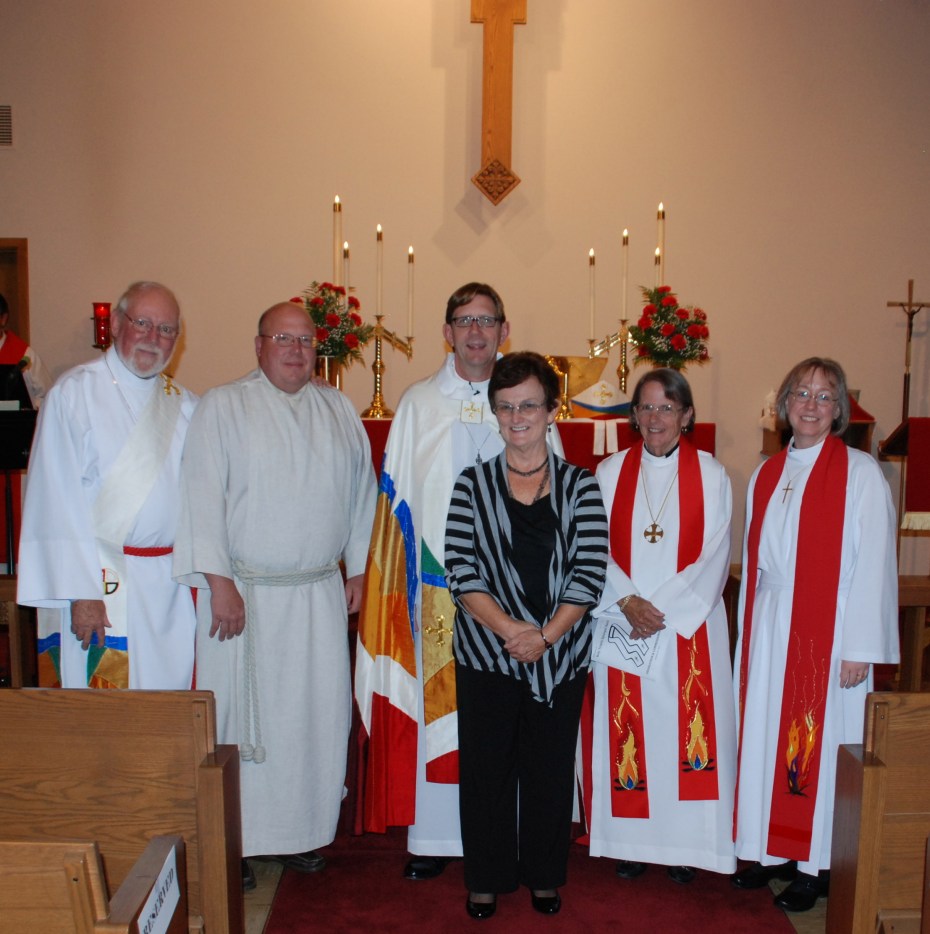
HTEC Total Ministry Team October 2011
12/25/11; IN THE BEGINNING by Samantha Crossley +
Christmas Day; John 1: 1-14
“Jesus is the reason for the season.” A popular catch phrase, meant to remind us that Christmas is not all about sales and glitter and food and presents. I was reminded the other day that some would claim that the tilt of the earth on its axis in the reason for the season. While that comment was intended as the comeback of the secular to the religious, my friendly neighborhood secularist was not wrong. Obviously, he is not wrong from a scientific perspective. The tilt of the earth on its axis is, in fact, largely responsible for the seasons. But he was not even wrong from a religious perspective.
According to former Episcopal Bishop Frederich Borsch, “There is no evidence of any kind regarding the date of Jesus’ birth. His nativity began to be celebrated on Dec. 25 in Rome during the early part of the fourth century (AD 336) as a Christian counterpart to the pagan festival, popular among the worshipers of Mithras, called Sol Invictis, the Unconquerable Sun. At the very moment when the days are the shortest and darkness seems to have conquered light, the sun passes its nadir. Days grow longer, and although the cold will only increase for quite a long time, the ultimate conquest of winter is sure. This astronomical process is a parable of the career of the Incarnate One. At the moment when history is blackest, and in the least expected and [least] obvious place, the Son of God is born…”
John would not have known of Christmas celebrations – they started long after he was gone, and they probably wouldn’t have made much sense to him in their current form – but he did know about the importance of light.
Yesterday evening we heard the familiar Christmas story from Luke’s perspective. It’s a beautiful story, complete with radiant, beaming new mother, attentive, caring father, cherubic infant. The angels sing and the shepherds keep watch, and all the world sings God’s praise. The images and emotions evoked are warm and tender and loving.
John, however, is not a storyteller. John is a mystic. John is a poet. John is not a romantic.
John begins his Gospel earlier than any of the others. Mark begins with John the Baptist. Matthew tells us of Jesus’s genealogy, Luke carefully places Jesus’s birth in place and time. There’s good evidence that John had access to Mark, Matthew and Luke’s materials. He knew about the wise men and the sheep and the sweet baby and all the rest. But, for John, that is not the beginning.
John begins at the beginning. Before Genesis. When Christmas really starts. In the beginning was the Word, and the Word was with God, and the Word was God. As the Rev. James Ligget says, “using language evocative of Genesis, John begins by talking about the Word of God — the Word of God here is God in action, God creating, revealing, and redeeming. The Word was with God, and the Word was God.” And then he tells us the birth story. In nine words. “And the Word became flesh and lived among us.”
With matter/energy transformations, time warps and tense shifts to give nightmares to physicists and English majors alike, John describes the indescribable. The Word that was before the beginning. The Word is with God. The Word is God. The Word is the true light. The Word is flesh, but through the Word made flesh, people of flesh might become children of God.
And so, as we pass the solstice, and our days grow longer (if not necessarily warmer), we celebrate the coming of the Light. God in Christ is with us still – the Word is eternal, the Light remains. If we open our eyes of our hearts to the light, we see God in the everyday – in shoveling snow, and in folding laundry, in the feast we share here and in dinners alone, in good-morning kisses and in good-bye hugs, in the moment we look into the eyes of one of the world’s outcasts and know that person is a child of God. As one commentator says, “It is why we aim to live the Christian life by not only talking about it or thinking about it, but by doing it—why our prayers are not only those of the heart, but those of the hands and the feet. (KIMBERLY BRACKEN LONG) May we live always in Light. May the light live always in us. Glory to God!
12/24/11, NEW LIFE by Samantha Crossley +
Christmas Eve; Isaiah 9:2-7, Luke 2:1-14, (15-20)
The people who walked in darkness have seen a great light; those who lived in a land of deep darkness, on them light has shined.
Our Northern nights have become long, and even during the short days the sun is pale and often shrouded in clouds. We yearn for the sunlight, and we yearn for the great light, the light of the soul.
The cacophony of advertisements and store displays call out their promises of fulfillment. This or that shiny trinket or fancy gadget will deliver happiness. The other pretty bauble will make someone love you forever. We feel the false promise of this light. It is bright, but it offers no warmth and we travel on, searching.
The political campaigns, barely started, already run long, each political hopeful with promises of transformation. We have heard these promises before. But the wealthy still wield the power, and the hungry remain hungry. Wars rage on and people still kill people.
We walk on to our Bethlehem, traveling with Mary and Joseph. Searching. Waiting. Waiting for the extraordinary.
But the walk proves ordinary, disconcerting in its normalcy. A man and his young, very pregnant bride travel the 70 odd miles by foot (and donkey) to pay their taxes. What could possibly be more ordinary than taxes? We earn our livings, shovel our snow, have our children, pay our taxes. Where is God in all of that? And so we wait.
“With a gulp of a newborn’s first-breath, God says, ‘The wait is over.’ As the cries of an infant pierce the night air, the heavens explode and angels sing in unbridled song” (anna murdock). For a child has been born for us…and he is named Wonderful Counselor, Mighty God, Everlasting Father, Prince of Peace. And we gasp at the compelling vulnerability of this Mighty Prince – wrapped in bands of cloth and rooting for his mother’s warmth, dependent in all things, like every baby before him, and every baby to come.
The shepherds are called forth from their fields. Menial laborers, shiftless slackers, won’t ever amount to anything but shepherds. Calmly tending their flocks in their peaceful fields, they are errified by angels, bidding them to seek the Savior. They hurry to the side of this Savior, this Lord – where they find a barn. Filled with warm, musty animal smells and makeshift blankets and diapers and the indescribable, exhausted joy that comes with new life.
New life comes with new promise. This baby will grow up. He will change the course of human history. He will become a radical advocate of love and justice. He will lift up the poor and the needy and the sick and the marginalized and give them voice. Without ever raising an army he will become powerful enough to threaten the mighty Roman Empire.
Right now, tonight, we are reminded he came as a baby, a simple miracle of life, to an ordinary man and woman, made extraordinary by their willingness to live their faith. He was greeted in this life not by trumpets and fireworks but by the warm breath of cows and the quiet glow of candlelight. His birth was proclaimed, not in the seats of power, but among the marginalized of society.
Let us travel to our Bethlehem. On this journey the extraordinary is born in the ordinary, the Holy suffuses the world. Let us welcome the promise of new life into the rooms of our lives, making way for the helpless and thereby hosting the enfolding love of God. May the child of Bethlehem be born in us this day. May we live the life he was born to teach us. The wait is over. Let us sing with the angels, Glory to God in the highest heaven, and on earth, peace.
12/4/11 CRAZY PEOPLE by Samantha Crossley +
Second Sunday of Advent; Isaiah 40:1-11, 2 Peter 3:8-15a, Mark 1:1-8
My grandmother used to say, “All the world is crazy save me and thee (and sometimes I think thou art a bit tetched).
Crazy people. We’re hearing from crazy people today. Isaiah’s constructing highways in the desert, Peter can’t distinguish a day from a millennium, Mark can’t figure out which century he is in, and John the Baptist… Well. John is one disturbed individual. That’s what you would think if he showed up one day at the coffee shop anyway.
John the Baptist was the son of a temple priest, Zechariah. His family, friends and neighbors would naturally have assumed that he would aspire to the same respectable line of work. We know virtually nothing of John’s early life – but somehow he went from presumptive heir to a lofty temple position to running around the desert in camel’s hair, indulging in a very questionable diet and plunging people into the Jordan with strident demands for repentance. Mark says “all the people of Jerusalem were going out to him, confessing their sins and being baptized”. Good grief! They must be crazy too. Who wants to spend a day hiking out to be preached at and dunked in the river after confessing your sins before all and sundry?
Why are we having this conversation with ancient crazy people as we await the coming of the Christ child?
We’re having this conversation because, for Mark, this is the beginning. Advent means arrival. The arrival of Jesus the Christ into this crazy world of ours is the beginning we await.
Nothing arrives in void; everything happens within a context. The Gospel of Matthew tells of Jesus’s genealogy – laying down the Messiah’s credentials. Luke, terribly organized, says “I too decided, after investigating everything carefully from the very first, to write an orderly account for you..so that you may know the truth.” Blessed Mark, ever succinct, skips all the introduction and says simply, “The beginning of the good news of Jesus Christ, the Son of God.” Period. Then he launches us back through the centuries to the prophet Isaiah – Isaiah and his message of hope.
Isaiah spoke to a people in exile, defeated, uprooted and displaced. He brings a message of hope to a hopeless people. In his lyrical way, he imparts this tender image to God’s languishing people, “He will feed his flock like a shepherd; he will gather the lambs in his arms, and carry them in his bosom, and gently lead the mother sheep.” Isaiah exhibits the joyous urgency of the Advent season in his cry, “In the wilderness prepare the way of the LORD, make straight in the desert a highway for our God.”
Mark draws on more than Isaiah’s poetic words of hope. His reference to a messenger comes from the book of Malachi, written after the exile, and hearkens also to the angel of Exodus. And so, as we slip with Mark through the centuries, we find that all things point to the messenger. Enter John the Baptist. An anchor in time where we can sit and contemplate the coming Messiah, right?
There is something about John the Baptist. Crazy or holy or both, there’s just something compelling about him. His appearance associates him inevitably with the prophet Elijah. Maybe that’s it. Maybe it’s his obvious sincerity. I mean, most people want the credit; for…whatever. People, generally speaking, crave thanks, glory, recognition. For example, if something popular happens when any given politician is in office, you can bet that politician won’t be saying, “Ah, but the groundwork was laid by the people in office before me. And wait till you see what the next person in office can do….” Clearly John had charisma, a following. He could have lived as if he were, himself, the alpha and the omega. Yet he physically, visibly lived the essence of his history and pointedly testified to the wonder of the gift to come. John points forward to Jesus the Christ, but still more, to the gift of the Spirit.
But who can really be comfortable with John the Baptist? “Comfort, oh comfort my people, says your God” But that’s not really the same as let’s sit back and be comfortable, is it? Like the crowds flocking to John’s side, we yearn for God, but we kind of want to sit back and let Him come to us. What does God need a highway for anyway?
God doesn’t. The highway is our invitation to God. God is always with us, and in us. But as Mark and Isaiah and Malachi and John and how many more of God’s messengers tell us the relationship does not come gift-wrapped. Some assembly is required.
Maybe it’s time to brave the discomfort John the Baptist proposes. REPENT, he says. The greek word is “metanoia”. Change your thinking. That’s what the Greek word means, change the way you think. It’s not about self-flagellation and abasement and groveling. It’s about transformation. A certain humility is involved, to be sure. At some point we have to realize that the universe does not revolve around us. John knew it, and prepared the ground for people to accept the One to come. Mark allows us to see the coming of the Christ through the lens of John, focused by the perspective of Isaiah and Malachi, and all the experience of God’s people. Mark shows us that we must look back so that we can look forward.
Look back. Look at your life, the life of our families, our community, our church, our nation, our world. Really look. Do you find anything that is not fit for the King of Kings, where righteousness would not be at home? Inequality? Poverty? Self-centeredness? Hate? Violence? Persecution? Ignorance? See it and name it. That is confession – naming that which is not right. Like any problem, if you cannot name it, you cannot change it. This is not easy. It is not comfortable, like any hard work is not comfortable.
See what is wrong: that which does not foster love and justice. And then repent, change your thinking. Repentance is not an event. It’s a slow and laborious process. Building a highway takes time. But changing your thinking will eventually change your actions and, with God’s help, your actions will change the world. One tiny turn, one tiny hummock at a time, straighten out the bends and flatten the hills in your life as we eagerly await the coming of He who baptizes with the Holy Spirit, that we might lift up our voice and our strength and cry without fear from the mountain top, Here is your God!
Praise be to God!
AMEN!
 Holy Trinity Episcopal Church